
So in my quest to further build my Superman ‘78 collection, I came upon an interesting foreign language variant of the highly successful miniseries from 2021-22 written by Robert Venditti and illustrated by Wilfredo Torres. And this one was two years in the making for me.
I first came upon this variation, entitled Superman 1978, online through a series of searches on Google and X (the former Twitter) which led me to an overseas website entitled Buscalibre, which had the graphic novel collection for sale. It was the first foreign language translation of the series that I came across, and the price wasn’t too bad for it. Thirty-five dollars, and I would have had it delivered to my door. But there was one significant problem that prevented me from getting Superman 1978.
It was the summer of unfortunate transition for me. I was in between jobs after suffering a serious work-related injury that kept me sidelined for weeks, and I had to treat my injuries all on my own and learn how to walk again. That summer I began to experience the first of a series of physical health issues related to my type-2 diabetes which had begun in 2009 and which I had held at bay for most of that time. Now things were changing, and before long my concern was not about some graphic novel from overseas. My concern was my health and my very life. So I had to put Superman 1978 on the back burner as I recovered, but I never forgot about it.
Over the course of the next two years I balanced my work life and my situation with my diabetes, which continues to this day. And in that time I found two more foreign language translations of Superman ‘78, one in German for the Kindle and Apple Books apps (which I have previously commented on), and one in Korean that mirrored the American hardcover version. But still I never forgot Superman 1978, even as the second series The Metal Curtain was released, and even as I found further cover variants of the first issue of the first series. My collection was growing in leaps and bounds.
Then in early May of this year, everything came full circle for me. On a whim I happened to look on Amazon, and lo and behold, there it was! One copy in stock for 21 dollars plus shipping. I pulled the trigger, and it was a lock for me! Two weeks later it arrived at my doorstep, and the quest was finally complete.
So what makes this Spanish version of Superman 1978 different from the other versions? First of all, this is licensed to ECC Ediciones, a Spanish imprint that handles primarily DC Comics but also numerous manga and other smaller labels for the Spanish markets overseas. Apparently their release of Superman 1978 in June 2022 was a massive success, and it went back in March 2023 for a second printing.
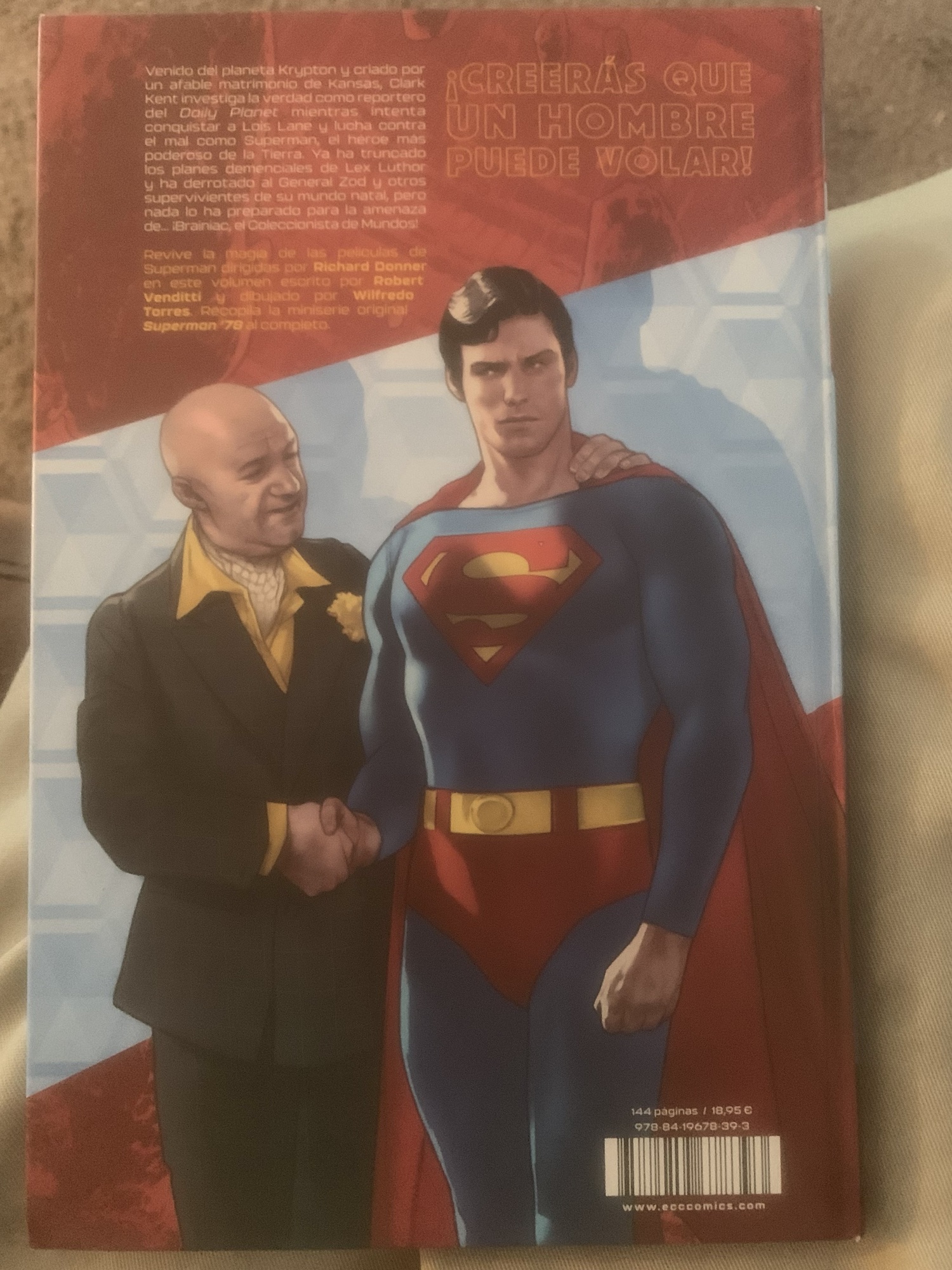
As opposed to the English and Korean versions, the Spanish version does not come with a slipcover but it is in hardcover format. And the back cover text is pretty straightforward with the familiar movie poster tagline “You’ll believe a man can fly!” in Spanish. (It would be interesting to find the classic film poster with the tagline in Spanish. I’m sure there’s one out there…)
And the back cover copy translates as follows:
“Coming from the planet Krypton and raised by a kindly Kansas couple, Clark Kent investigates the truth as a reporter for the Daily Planet while trying to win over Lois Lane and fight evil as Superman, Earth’s most powerful hero. He’s already thwarted Lex Luthor’s insane plans and defeated General Zod and other survivors of his home world, but nothing has prepared him for the threat of… Brainiac, the Collector of Worlds!
“Relive the magic of the Superman films directed by Richard Donner in this volume written by Robert Venditti and drawn by Wilfredo Torres. Collects the original miniseries Superman ‘78 in full.”
As for the interior content, all of the different covers of the original series and many of their respective variant covers are included in this Spanish volume, with the newsstand covers and the 1:25 pencil sketch variant cover separating each chapter, while the variant covers are included in a separate section at the end of the book. The translation itself is ably handled by Felip Tobar Pastor and edited by Gustavo Martinez, who have successfully translated the copy for Spanish readers.

The volume begins with the Mico Suayan variant cover and a new foreword written by Fran San Rafael, which covers the history of the Man of Steel from the comics to the cartoons, the television series, and the movies, along with the development of the Superman ‘78 series. Here is that foreword translated into English, which is cleaned up for any language inaccuracies:
THE RETURN OF SUPERMAN
By the end of the seventies, the world had already enjoyed several adaptations of the adventures that the Man of Steel had lived in comics for four decades. First came the radio serial from the WOR station, which premiered in 1940 and from which emerged characters as important to the mythology of the character as Perry White or Jimmy Olsen. It was also where kryptonite was born as a common resource whenever Bud Collyer, the protagonist, needed a break and his staff had to go offside for a good part of an episode. Later the Fleischer cartoons would arrive, a milestone that had a very high budget at a time when Did eyes was beginning to monopolize the field of animation. Already in the early fifties, Superman and the Mole Men arrived, the film starring George Reeves that would give rise to a television series shot in black and white. For a generation of Americans, it was the definitive version of the character.
The world was not prepared for what Superman was going to entail when it was released in 1978, many years after the last adventures starring Reeves. Between one adaptation and another, several more animated versions had emerged, but it was Christopher Reeve’s Man of Steel who made us believe that a man could fly. The project arose when Warner Communications became the parent of DC Comics, which opened the door to endless possibilities. The superhero chosen to open fire was the most emblematic, of course, in a production that was initially going to be directed by Steven Spielberg, having recently arrived at the Hollywood Olympus with Jaws. However, the popular had already committed to another project (Close Encounters of the Third Kind), so it was Richard Donner, who had also gained notoriety shortly before (in his case, with The Omen), who would take charge to adapt the best-known superhero in the world.
Superman had several important names who endorsed the film at the box office. John Williams, who had already had some successes, was chosen to compose the soundtrack, which left us with unforgettable songs such as the famous fanfare. Mario Puzo, the writer of the novel The Godfather, was in charge of the script. For his part, Marlon Brando played Jor-El in a brief role that, however, became one of the film’s biggest draws. It was he who welcomed the spectators to the aseptic Krypton of Donner (the one to which we will return in the next pages) before we saw the plains of Kansas and a sumptuous Metropolis where Reeve convinced us as Clark Kent and fascinated us as Superman, all without detracting from the memorable performances of Margot Kidder (Lois Lane) and Gene Hackman (Lex Luthor). Curiously, one could say that Reeve did not meet the physical standard that a superhero seemed to require (and that there was another possible candidate for the role, Arnold Schwarzenegger), but what muscle justifies a man lifting a helicopter?
The film was a great success that generated an entire franchise that was shortly followed by Superman II, with the appearance of the three Kryptonian criminals that Jor-El had locked up in the Phantom Zone. Later, two more films would arrive, to which Supergirl would be added, but the stories contained in this volume take place after the second installment. With it, DC Comics recovers the spirit of the comics it has published recently, based on great adaptations of the past such as Batman 1966, Wonder Woman 1977, or Batman 1989. The latter returns us to Tim Burton’s Gotham City, via the hand of Sam Hamm (the scriptwriter of the original film) and artist Joe Quinones, and we will be able to enjoy it serialized month after month by ECC Ediciones.
The creators of Superman 1978 are writer Robert Venditti, a regular at DC Comics who has written for major characters such as Green Lantern and Aquaman, and artist Wilfredo Torres, who already participated in Batman 1966 a few years ago. It was Torres who made it clear on the publisher’s website: “There is no fictional character I love more than Superman. Of all the interpretations there have been in animation, television and film, the version by Christopher Reeve and Richard Donner is the one I like the most. Working on this project is a childhood dream come true.”
Surely there are many readers who identify with these words of the artist and who are going to thoroughly enjoy this volume, where we will remember Reeve, Hackman and Kidder, and where we will see for the first time in the history of this Superman a villain that many have claimed for years a true heavyweight from the Man of Steel’s mythology. This is Brainiac. And since the various subsequent films have not featured him, it is wonderful to be able to see him facing the hero that several generations consider the definitive Superman.
While we glean no new information about the films themselves, it is clear that Fran San Rafael loves the films and knows the Superman franchise well.

Unfortunately with this Spanish translation (and there is one big unfortunately that I have to mention here), it does not include the heartfelt tribute to Richard Donner that was included in the first issue, as well as the German and Korean versions. This is a loss to be sure, and I’m sure the editors could have spared an extra page or two to include the Donner tribute, since his vision of verisimilitude was so influential to the first two Superman films and was continued by Robert Venditti and his artists in the two stories thus far.
Bottom line: if you’re on the hunt for foreign editions, this is a great addition to your collection. And with that, if there are any other foreign language translations of Superman ‘78 that are out there in the wild or under the proverbial radar, I would love more than anything to know about them and add them to my growing collection! And when we see The Metal Curtain gathered into a graphic novel collection, you can bet your bottom dollar that I’ll be there to get as many versions as I can, including all of the foreign language translations that I can locate.
 Superman: The Blog